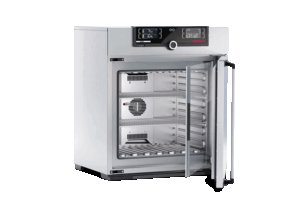
As the technology leader in Peltier laboratory appliances, Memmert sets new standards with Advanced Peltier Technology: the Constant Climate Chamber HPPeco and the Cooled Incubator IPPecowith Peltier technology work more energy-efficiently, economically, precisely, powerfully and quietly than any other comparable appliance ever before.
With Advanced Peltier Technology, Memmert has practically doubled the efficiency of the entire heating and cooling technology compared to comparable appliances, saving up to 90 % energy in comparison to compressor-cooled climate chambers and cooled incubators.
In 2000, Memmert succeeded for the first time in adapting the Peltier principle for more powerful laboratory appliances - and then heating and cooling them with a single system. To date, no other manufacturer offers a comparable variety of Peltier-appliances with an interior volume of up to 2140 l, which are cooled and heated with Peltier technology in the temperature range between 0 and 70 °C.
At working temperatures close to the ambient temperature, Peltier technology is particularly economical and energy-saving because, in contrast to compressor technology, energy is only required when heating or cooling is needed. The thermal energy in the room environment is converted into heating energy and thus replaces a part of the electricity required.
Heating and cooling in a single system: If a voltage is placed across a Peltier element, one side is cooled and the opposite side simultaneously heats up. Simply by reversing the polarity of the supply voltage, the hot and cold sides of the Peltier element can be swapped.
Peltier elements are probably the best-known industrial application of the Peltier effect. These are connected in series. The contamination with extraneous atoms causes a difference in the conductivity of the two materials. If a voltage is applied to the terminals on the semiconductors, some of the energy is converted into heat. One side of the Peltier element becomes cold, as energy is extracted from it by passing an electrical current through it, while the other side releases the heat extracted from the cold side into the environment.
Peltier elements function as an electronic heat pump in the constant climate chamber HPPeco and Peltier-cooled incubator IPPeco.

During the heating operation, the heat energy is extracted from the ambient air and fed to the interior. There is no exchange of outside air and the interior is thus not dehumidified. The physically induced, unavoidable dripping water during the cooling process does not take place inside the constant climate chamber HPPeco and peltier-cooled incubator IPPeco, but outside the working space at a humidity trap. There, the condensate is fed specifically into a collection tray.
In a Peltier-cooled incubator or climate chamber, Peltier elements are integrated into cooling units. To avoid overheating of the Peltier elements, to optimise efficiency and, above all, to enable the greatest possible temperature difference between the cold and hot sides, the waste heat must be removed as efficiently as possible. This is done with an (demand-controlled) external fan and a sufficiently dimensioned cooling element. Ideally, the internal fan motor should introduce as little heat as possible into the interior.

Máxima eficiencia energética en funcionamiento continuo: hecho a medida para estudios de estabilidad de acuerdo con las directrices del ICH, pruebas de estabilidad para cosméticos y alimentos, así como pruebas medioambientales y de materiales

 Temperature
 Humidity
 Light
Light
Marca la pauta medioambiental para cultivos por debajo de la temperatura ambiente: un ahorro de energía incomparable y los mejores valores para los tiempos de calentamiento, refrigeración y recuperación.
Temperature